


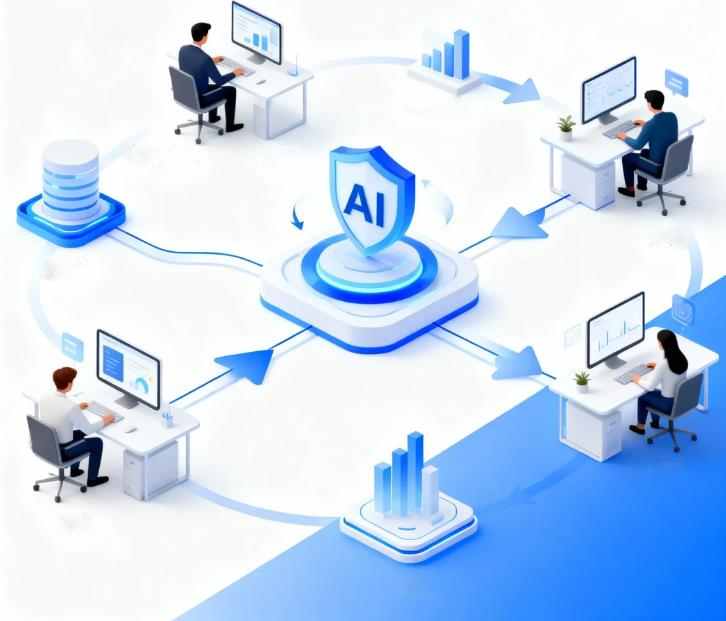

In the modern business landscape, few forces are reshaping operations as rapidly and dramatically as artificial intelligence. What began as a set of niche technologies—machine learning models, natural language processing, early robotic process automation—has evolved into a powerful ecosystem of AI-driven workflow automation tools that permeate nearly every department of the enterprise. Today, AI is not simply something businesses “experiment with.” It has become a strategic component of operations, productivity, cost efficiency, and long-term competitiveness.
For companies in North America, Europe, and other mature economies, AI workflow automation is no longer optional—it is a requirement for survival in a market that demands operational speed, lean resource utilization, and flawless digital experiences. From small startups to multinational corporations, organizations are redesigning how work is done by delegating repetitive tasks, decision-making routines, and complex multi-step workflows to intelligent automation systems.
This article provides a deep exploration into the world of AI workflow automation: how it works, why it is exploding in adoption, the key benefits enterprises see, the tools leading the market, and how companies can prepare for an increasingly automated future. With a focus on practical application and industry-specific insights, this comprehensive guide is designed to help modern businesses understand both the strategic and technical dimensions of AI automation—and how to capitalize on them.
What Exactly Is AI Workflow Automation?
AI workflow automation refers to the use of artificial intelligence technologies to design, manage, and execute business processes with minimal or zero human involvement. Unlike traditional automation, which relies on fixed rules and rigid scripts, AI-powered automation can:
- Understand natural language instructions
- Learn from patterns and data
- Make decisions based on context
- Adapt to new situations
- Trigger downstream workflows autonomously
At its core, AI workflow automation blends three main pillars:
1. Intelligent Process Automation (IPA)
This integrates AI with robotic process automation (RPA), allowing bots to handle tasks that require more than “if-this-then-that” logic.
2. Cognitive Capabilities
Natural language processing (NLP), computer vision, and machine learning allow systems to understand and interpret data the way humans do.
3. Autonomous Agents and Orchestration Layers
These new AI agents can coordinate multi-step workflows, hand off tasks across tools, and even collaborate with other automation systems.
In simpler terms:
Traditional automation follows instructions. AI automation figures out what to do.
This distinction is pivotal. It transforms automation from a static cost-saving tool into a dynamic collaborator capable of scaling, learning, optimizing, and handling complex workflows across departments.
Why AI Workflow Automation Has Become Essential for Modern Businesses
Multiple global trends have accelerated the adoption of AI automation across Western markets:
Trend #1: Rising Labor Costs and Talent Shortages
In the U.S., Canada, the U.K., and the EU, businesses face increasing labor costs and difficulty hiring specialized staff. AI fills operational gaps without sacrificing productivity.
Trend #2: Digital Transformation and Cloud SaaS Ecosystems
Most Western companies rely heavily on SaaS—CRMs, project management tools, collaboration platforms. AI automation now integrates these tools, removing manual handoffs.
Trend #3: Explosion in Business Data
Organizations generate more data than humans can possibly process. AI automates data analysis, classification, extraction, and decision-making.
Trend #4: Customer Expectations for Instant Response
From customer support to logistics, modern consumers expect fast, accurate, 24/7 service. AI automation enables this without staffing 24-hour teams.
Trend #5: Tougher Competitive Pressures
Companies that automate scale quickly. Those that don’t fall behind.
For these reasons, the question businesses now face is not whether to use AI workflow automation, but where to start and how quickly to expand their capabilities.
Key Business Functions Transformed by AI Workflow Automation
AI workflow automation now touches almost every department within a modern enterprise. Below are the areas where adoption is growing fastest.
1 Customer Support and Service Automation
AI-driven customer service is one of the highest ROI use cases for automation.
Where AI is used:
- Chatbots and virtual assistants
- Automatic ticket triage
- Intelligent routing based on sentiment
- Email response automation
- Self-service knowledge bases
- Voice AI for call centers
Example workflow:
A customer emails support → AI categorizes the issue → determines urgency → suggests or drafts a response → escalates only if needed → updates CRM records automatically.
Why it matters:
Businesses in the U.S. and EU save millions by reducing Tier 1 inquiries. And customers enjoy faster, always-available service.
2 Sales and Marketing Automation
Sales and marketing teams increasingly rely on AI to personalize communication, track leads, and optimize outreach.
Common use cases:
- AI-driven lead scoring
- Automated CRM updates
- Personalized email sequences
- Smart ad targeting
- Predictive analytics
- Proposal generation
- Automated follow-up workflows
Example:
After a prospect downloads a whitepaper, the AI automatically:
- Scores the lead
- Enrolls them in a personalized email sequence
- Schedules a rep call if they interact with specific content
- Logs everything in the CRM
This level of automation drastically improves conversion rates and reduces manual workload.
3 Finance and Accounting Automation
Financial operations generate large amounts of structured and unstructured data—something AI is exceptionally good at handling.
AI use cases in finance:
- Invoice processing
- Expense validation
- Document extraction with OCR
- Risk scoring
- Fraud detection
- Financial forecasting
- Automated reporting
Example workflow:
Supplier invoice → AI extracts data → matches to purchase order → approves or escalates → posts to accounting software.
The result: fewer errors, faster close cycles, and better financial visibility.
4 Human Resources and People Operations
AI has become indispensable in HR departments, especially for recruitment and employee management.
AI automates:
- Screening candidates
- Scheduling interviews
- Generating job descriptions
- Onboarding workflows
- Compliance documentation
- Performance tracking and analytics
Example workflow:
Candidate applies → AI reviews resume → ranks their fit → schedules interview → sends onboarding documents upon selection.
This dramatically reduces HR workload and speeds up hiring.
5 IT Operations and Incident Management
IT teams face heavy workloads and increasing complexity. AI automation handles repetitive tasks and assists in decision-making.
Key use cases:
- Automated ticket triage
- System monitoring and anomaly detection
- Access provisioning
- Security workflows
- Software deployment pipelines
Example:
A security alert is detected → AI analyzes logs → categorizes threat level → initiates containment procedures → notifies security team.
This shortens incident response time and strengthens cybersecurity posture.
6 Operations and Supply Chain Automation
Global supply chains are complex and data-intensive, making them ideal for AI automation.
AI enables:
- Inventory forecasting
- Logistics optimization
- Automated procurement workflows
- Supplier risk scoring
- Workflow orchestration across ERP systems
Example:
Inventory drops below threshold → AI triggers procurement → selects best supplier → auto-generates purchase order → updates ERP.
This improves accuracy while reducing operational costs and delays.
The Business Benefits of AI Workflow Automation
Companies adopting AI automation report improvements across both financial and operational dimensions. Here’s why executives across the U.S. and Europe are investing aggressively in intelligent automation.
1 Significant Cost Reductions
Automation reduces labor requirements in repetitive or data-heavy areas. Organizations typically see:
- Lower headcount needs for manual tasks
- Reduced overtime and operational costs
- Fewer errors that lead to expensive corrections
- Decreased reliance on external services
For many businesses, the ROI is realized within months.
2 Major Productivity Gains
AI completes routine tasks far faster than humans. Teams reclaim hours of time every week to focus on higher-value work, such as strategy, creativity, and customer engagement.
3 Improved Accuracy and Consistency
Automation systems operate with:
- No fatigue
- No attention drift
- No variability
Errors in finance, logistics, support, and operations decline dramatically.
4 Enhanced Customer Experience
Consumers in Western markets expect fast, personalized, reliable experiences. AI helps businesses deliver this at scale—without constantly expanding their workforce.
5 Scalability Without Hiring Constraints
AI automation enables companies to handle more:
- Customers
- Orders
- Invoices
- Support tickets
- Internal requests
…without proportionally increasing staffing.
This is especially valuable in markets where salaries and benefits are high.
The Leading AI Workflow Automation Tools for Enterprises
Western businesses increasingly rely on powerful automation platforms such as:
1. Zapier
Ideal for small to medium businesses needing user-friendly workflow automation.
2. Make.com (formerly Integromat)
More advanced and visual automation builder for complex workflows.
3. UiPath
Enterprise-grade robotic process automation with strong AI integration.
4. Power Automate (Microsoft)
Deeply integrated with Microsoft 365, ideal for large organizations.
5. n8n
Open-source automation for companies wanting customization and self-hosting.
6. HubSpot Automation
Powerful marketing, sales, and CRM automation suite.
7. Salesforce Einstein
AI-driven automation across CRM, analytics, and customer engagement.
8. Notion AI and ClickUp AI
Growing as hybrid task management + AI orchestration solutions.
9. ServiceNow
Industry leader in IT workflow automation and service management.
These tools form the backbone of modern enterprise automation ecosystems.
6. Industry-Specific Use Cases: How Different Sectors Apply AI Automation
Each industry adopts AI workflow automation differently. Below are the strongest examples across high-value sectors in North America and Europe.
1 Finance & Banking
- AI loan underwriting
- Automated transaction monitoring
- Regulatory compliance workflows
- Intelligent credit scoring
- Fraud detection systems
2 Healthcare and Medical Services
- Patient intake automation
- Medical documentation processing
- Scheduling and billing
- Claims management
- AI-assisted triage
Automation reduces administrative burden in systems that are historically overloaded.
3 Legal Services
- Contract analysis
- Document review
- Case preparation workflows
- Compliance tracking
- Legal research automation
Law firms increasingly rely on AI automation to reduce costly admin work.
4 Real Estate and Property Management
- Lead qualification
- Lease document processing
- Automated maintenance scheduling
- Pricing analytics
5 E-commerce and Retail
- Inventory forecasting
- Order processing
- Customer support
- Returns management workflows
- Marketing automation
6 Manufacturing and Logistics
- Predictive maintenance
- Production scheduling
- Supplier coordination
- Quality inspections with computer vision
Across these industries, AI automation moves organizations toward faster, more accurate, more resilient operations.
How to Implement AI Workflow Automation Successfully
Adopting AI automation is not just a technical upgrade—it’s a strategic transformation.
Here’s how successful organizations implement it:
Step 1: Identify High-Impact Workflows
Ideal workflows share characteristics:
- Repetitive
- Rules-based or semi-structured
- Data-heavy
- Error-prone
- Time-consuming
Step 2: Map Your Systems and Data Flows
AI automation requires connecting:
- CRM
- ERP
- HRIS
- Support systems
- Databases
- Project management platforms
Knowing your data sources speeds implementation and improves accuracy.
Step 3: Start With High-Value Tools
Select tools with strong integrations, good documentation, and enterprise-level support.
Step 4: Build Incrementally
Start small:
- Automate one workflow
- Test
- Improve
- Scale to new departments
Step 5: Train Teams and Redesign Roles
Automation works best when teams understand how to collaborate with AI systems rather than compete with them.
Step 6: Monitor and Optimize Workflows Continuously
AI automation is not “set and forget.”
It improves as you refine inputs and expand capabilities.
8. Risks and Challenges to Address
For Western businesses, responsible AI adoption includes managing risk.
Key concerns include:
1. Data Security
Ensure data encryption, access control, and compliance with SOC 2, ISO 27001, GDPR, and CCPA.
2. AI Explainability
Decision-making by AI must be transparent—especially in regulated industries.
3. Integration Complexity
Legacy IT systems may require custom integration work.
4. Workforce Reskilling Requirements
Automation changes job roles; training is essential.
5. Over-automation
Some processes still require human judgment. Balance is key.
9. The Future of AI Workflow Automation: What Comes Next
AI automation is accelerating toward a more autonomous, adaptive, and comprehensive future.
Trend 1: AI Agents That Operate Independently
Autonomous agents will run multi-step workflows with minimal human input.
Trend 2: AI-Native Business Systems
CRMs, ERPs, and HR platforms will move from “AI add-ons” to “AI-first architectures.”
Trend 3: Natural Language Orchestration
Employees will design and control workflows simply by describing them in everyday language.
Trend 4: Unified Enterprise Automation Platforms
Companies will replace dozens of SaaS tools with integrated AI-driven platforms.
Trend 5: Decision Automation
Beyond executing tasks, AI will increasingly propose—and eventually make—operational decisions.
Trend 6: Hyper-personalized Customer Experience
Automation will support more individualized, real-time service than ever before.
The next decade will redefine how work is performed on a fundamental level.
The Strategic Imperative of AI Workflow Automation
AI workflow automation has become one of the most transformative forces in modern business. It streamlines operations, reduces costs, enhances customer experiences, supports data-driven decision making, and enables organizations to scale faster than ever.
Across the U.S. and Europe, companies that adopt AI automation are outperforming competitors across every measurable dimension. Meanwhile, those who delay face operational inefficiencies, slower growth, and mounting competitive pressure.
The future belongs to businesses that can integrate AI into their workflows—not as a tool, but as a strategic partner.
As AI technologies continue to advance, workflow automation will play an increasingly central role in shaping the enterprises of tomorrow. The time to adopt, experiment, optimize, and scale is now.