


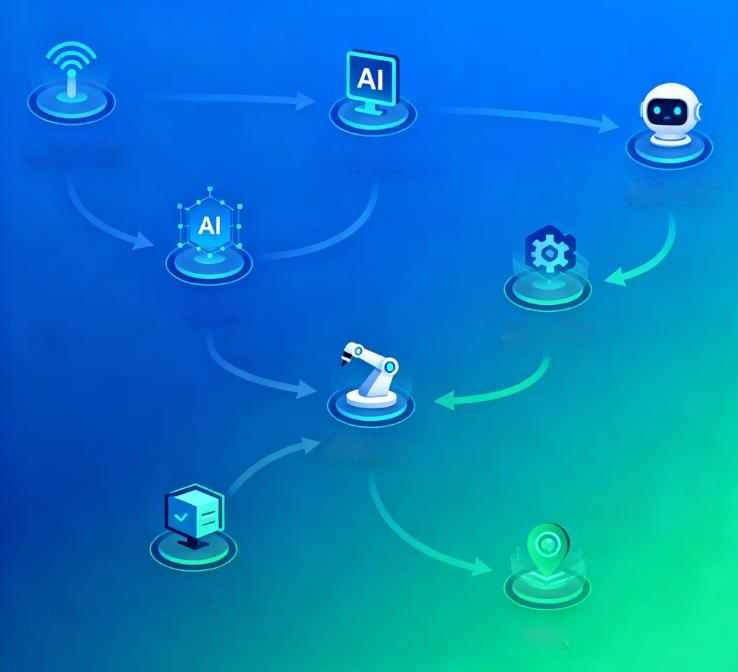

Why DevOps Needs AI Now
Software delivery has never moved faster. Release cycles have compressed from weeks to days—or even hours—yet expectations for reliability, performance, and security continue to rise. DevOps teams are expected to automate everything, catch every anomaly before it becomes an incident, and deliver flawless user experiences at global scale.
But despite advanced CI/CD pipelines and powerful observability platforms, teams still struggle with:
- Alert fatigue and excessive false positives
- Unpredictable infrastructure behavior under load
- Delays in deployment validation
- Limited visibility into cross-system dependencies
- Reactive rather than proactive incident management
This is where AI becomes transformative. Not as a buzzword, but as a practical operational capability.
AI in DevOps means augmenting existing workflows with machine learning, predictive analytics, and large language models (LLMs) to accelerate deployments and drastically improve monitoring accuracy.
It takes DevOps from:
- manual → automated,
- automated → intelligent,
- intelligent → predictive.
In the following sections, we’ll explore how AI-driven capabilities are reshaping deployment pipelines, enhancing monitoring, reducing risk, and enabling more autonomous operations. We’ll also cover real-world use cases, industry tools, architectural patterns, and strategic recommendations for organizations starting their AI-in-DevOps journey.
What AI in DevOps Really Means
Before diving into technologies and workflows, it’s important to establish a clear definition.
AI in DevOps refers to the use of machine learning models, intelligent automation, and LLM-powered reasoning to optimize, predict, and accelerate every stage of the software delivery lifecycle.
It includes (but is not limited to):
- ML-driven anomaly and incident detection
- Predictive scaling and capacity forecasting
- Automated deployment risk assessment
- Intelligent CI/CD gatekeeping
- LLM-powered incident triage and root cause suggestions
- Self-healing infrastructure
- AI-enhanced observability and metric correlation
AI doesn’t replace DevOps.
AI empowers DevOps to operate with greater speed, accuracy, resilience, and autonomy.
AI-Driven Deployment: Smarter, Faster, Safer Releases
Deployment is one of the highest-stakes moments in any release cycle. Even with automated pipelines, issues like regression bugs, misconfigurations, dependency mismatches, or environment drift can still slip into production.
AI introduces intelligence into these workflows.
Predictive CI/CD Pipeline Optimization
Traditional CI/CD runs on static rules: run tests, build artifacts, deploy on green signals. But pipeline failures often have hidden patterns—failed builds under certain conditions, flaky tests, resource spikes, or specific code paths correlated with instability.
AI can learn from historical pipeline data to:
- Predict build failures before execution
- Recommend pipeline optimizations
- Identify tests likely to fail
- Detect root causes of flaky tests
- Suggest parallelization strategies for faster build times
For example, ML models can analyze commit metadata, code diffs, test outcomes, and historical logs to produce a deployment risk score. High-risk deployments can be automatically routed for deeper review or additional validation steps.
Result:
Teams reduce wasted compute cost, accelerate feedback loops, and ship with higher confidence.
Intelligent Quality Gates
Instead of static thresholds like “test coverage must exceed 85%,” AI-powered gates evaluate dynamic factors such as:
- Impact radius of code change
- Risk profile of modified services
- Security exposure
- Runtime behavior predictions
- Similar historical failures
This yields more accurate pass/fail determinations and minimizes false approvals—especially important in microservice environments where dependencies are complex.
Automated Release Validation
AI can analyze logs, metrics, traces, and feature flags from pre-production systems to validate deployments automatically.
Examples include:
- Detecting abnormal spikes in CPU, memory, or error rates during canary releases
- Identifying anomalous user behavior after feature rollout
- Assessing whether performance regressions exceed acceptable ranges
Combined with automated rollback policies, AI systems can revert bad deployments without human involvement.
AI-Assisted Progressive Delivery
Modern deployment strategies—like canary, blue-green, and progressive rollout—benefit greatly from machine learning.
ML-driven rollout policies can:
- Automatically adjust traffic percentages
- Pause or accelerate rollout based on real-time stability
- Trigger rollback based on anomaly detection
- Correlate deployment events with user impact
This level of autonomy enables teams to ship more frequently with lower failure rates.
AI in Monitoring: From Reactive to Predictive
Monitoring is where AI delivers the biggest operational leap. Traditional monitoring systems generate alerts based on thresholds, but thresholds fail when workloads fluctuate or when unexpected patterns emerge.
AI transforms monitoring into a predictive, context-aware system.
ML-Based Anomaly Detection
AI-driven anomaly detection models analyze:
- Time-series metrics
- Log streams
- Distributed traces
- Event metadata
- Traffic patterns
Unlike threshold-based alerts, AI detects subtle changes such as:
- Gradual memory leaks
- Slow response degradation
- Unexpected traffic anomalies
- Configuration drift affecting behavior
- Latency spikes correlated with hidden dependencies
This dramatically reduces false positives and increases detection accuracy.
Predictive Incident Prevention
Predictive models can forecast:
- Imminent CPU saturation
- Database connection pool exhaustion
- Service degradation under expected load
- Disk or hardware failures
- SLO violations hours before they occur
This allows teams to intervene before users experience issues—shifting from reactive firefighting to proactive reliability engineering.
Smart Alert Routing and Noise Reduction
LLMs and classification models can analyze alerts to:
- Group related alerts
- Suppress non-actionable noise
- Identify duplicate symptoms
- Route incidents to the right team
- Auto-tag incidents based on historical patterns
This significantly reduces MTTA (Mean Time To Acknowledge) and improves team focus.
LLM-Assisted Incident Triage
During an incident, speed matters. LLMs can assist by:
- Generating immediate summaries
- Identifying probable root causes
- Suggesting next steps
- Pulling relevant logs or dashboards
- Mapping symptoms to previous incidents
Instead of searching documentation or dashboards manually, engineers get near-instant diagnostic insights.
Autonomous Remediation (Self-Healing Systems)
AI-powered remediation engines can automatically:
- Restart failing pods or services
- Roll back deployments
- Clear resource bottlenecks
- Update configurations
- Auto-scale resources
- Mitigate DDoS-like behavior
This allows infrastructure to heal itself, reducing downtime and manual intervention.
Security and Compliance: AI as a Force Multiplier
Security is becoming deeply embedded in DevOps workflows. AI enhances DevSecOps with:
AI-Powered Vulnerability Scanning
ML models detect:
- New vulnerability patterns
- Dependency risks
- Misconfigurations
- Suspicious infrastructure changes
- Unusual API usage
AI can outperform signature-based scanners by identifying unknown threat behaviors.
Real-Time Compliance Drift Detection
AI monitors infrastructure to detect:
- Unauthorized configuration changes
- Violations of policy-as-code rules
- Unexpected permission escalations
- Deviations from compliance baselines
Compliance becomes continuous and automated.
Intelligent Threat Response
LLMs assist security teams by:
- Correlating security events
- Explaining attack vectors
- Suggesting mitigation steps
- Classifying severity
This speeds up investigation and reduces risk exposure.
Real-World Use Cases and Industry Examples
Here are practical examples of how organizations benefit from AI in DevOps:
FinTech
A European FinTech company reduced MTTR by 42% using ML-based anomaly detection and automated incident grouping.
E-commerce
A global e-commerce platform achieved 65% automation in deployment validation, cutting release time in half.
Gaming
A real-time multiplayer gaming service used predictive autoscaling to reduce peak-hour latency by 30%.
Healthcare
A medical SaaS provider used LLM-powered triage to accelerate root cause analysis and meet strict reliability requirements.
SaaS Platforms
AI-enhanced CI/CD prevented ~28% of high-risk deployments from reaching production in a major SaaS vendor.
These examples highlight measurable business outcomes, not marketing hype.
Tools and Ecosystem: What’s Available Today
Cloud-Native AI DevOps Tools
- AWS DevOps Guru: anomaly detection, operational insights
- Google Cloud Operations + Vertex AI: predictive analytics
- Azure Monitor + Azure ML: integrated intelligence for telemetry
Observability Platforms with AI
- Datadog AIOps
- Dynatrace Davis AI
- New Relic AI
- Elastic Observability with ML jobs
AI-Powered Developer Tools
- GitHub Copilot
- GitHub Actions with ML triggers
- Codeium, Tabnine
Open Source
- Prometheus anomaly detection add-ons
- Argo Rollouts with AI-based traffic control
- KServe for ML inference in DevOps pipelines
The ecosystem is evolving rapidly, with nearly every major DevOps platform embedding AI capabilities.
Architecture Patterns for AI-Enhanced DevOps
To integrate AI effectively, organizations typically adopt one or more of these patterns:
Pattern 1: AI-Augmented CI/CD
ML models run as steps within the pipeline to approve, block, or recommend adjustments.
Pattern 2: AI-Enhanced Observability
Telemetry data feeds into inference models for real-time insights.
Pattern 3: Autonomous Remediation Layer
A decision engine monitors the system and initiates fixes autonomously.
Pattern 4: LLM Co-Pilot for On-Call
LLM agents assist with incident triage, documentation retrieval, and diagnostic suggestions.
Pattern 5: Centralized AI Operations Hub
A unified layer orchestrates ML models across deployments, monitoring, and security.
Challenges and Considerations
AI adoption isn’t plug-and-play. Organizations should anticipate challenges such as:
Data Quality and Integration
ML depends on high-quality logs, metrics, and traces. Missing data means incomplete predictions.
Model Transparency
Teams must understand how models make decisions—especially in security and compliance.
Human Oversight
AI supports DevOps but doesn’t replace engineering judgement.
Skill Gaps
Teams may require training in ML basics and AI-native workflows.
Cost Management
Inference at scale can be expensive; careful tuning is necessary.
The Future: Toward Autonomous DevOps
AI will push DevOps into a new era defined by:
1. Fully Autonomous Pipelines
Deployments that design, validate, and roll out features independently.
2. Self-Healing Infrastructure
Systems that detect, diagnose, and resolve issues without human intervention.
3. AI-Supervised Reliability Engineering
SRE teams focused on strategic improvements rather than firefighting.
4. AI as Part of the Toolchain
AI agents embedded in CLIs, IDEs, CI/CD, observability systems, and incident management.
5. Predictive Operations
Downtime prevented days—or even weeks—in advance.
This future is already materializing across large-scale systems.
Recommendations: How to Start AI in DevOps Today
Here’s a practical roadmap for organizations adopting AI:
Step 1: Start with Predictive Monitoring
It offers the fastest ROI and lowest barrier to entry.
Step 2: Add AI-Assisted Deployment Validation
Use risk scoring and anomaly detection during canary releases.
Step 3: Introduce LLM Assistance for On-Call
Deploy LLMs to summarize incidents and suggest probable root causes.
Step 4: Automate Remediation for Low-Risk Events
Restart services or auto-scale resources autonomously.
Step 5: Build AI-Native Pipelines
Embed AI decision steps in CI/CD.
Step 6: Move Toward Full Autonomy
Gradually increase automation levels while preserving human approval for critical operations.
AI Is the Next Evolution of DevOps
AI is not merely an add-on to DevOps—it is the next evolutionary phase.
With intelligent deployments, predictive monitoring, and AI-assisted incident management, organizations can achieve:
- Faster lead times
- Higher reliability
- Improved developer experience
- Lower operational cost
- Better customer satisfaction
The DevOps teams that learn to leverage AI will ship faster, break less often, and respond to issues in real time—often before customers even notice.
The future of DevOps is autonomous, intelligent, predictive, and powered by AI.
And that future has already begun.