


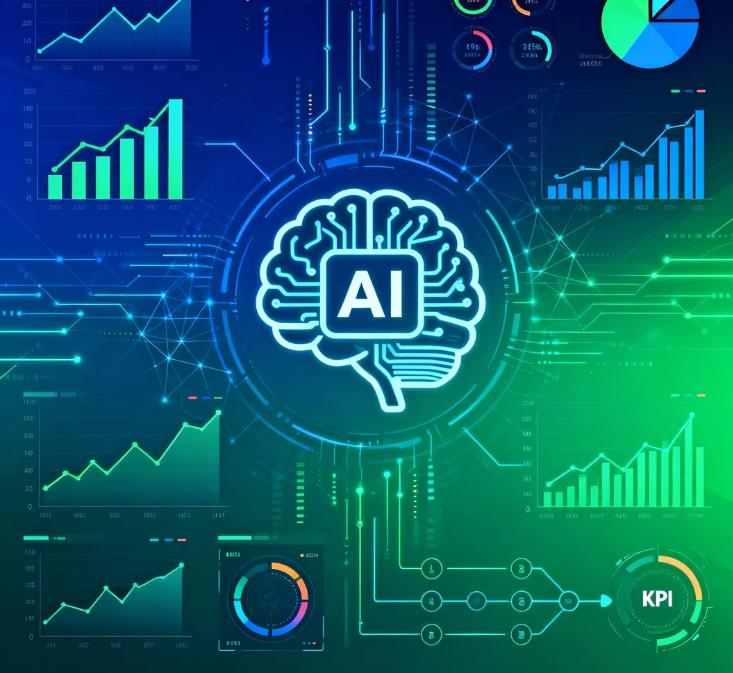

Artificial Intelligence (AI) has rapidly evolved from a peripheral technology to a core driver of competitive advantage in businesses across the globe. For companies in North America, Europe, and other digitally advanced regions, AI is reshaping how organizations collect, analyze, interpret, and act on data. When paired with Business Intelligence (BI) and modern data analytics capabilities, AI becomes a force multiplier—turning raw information into actionable insights at scale.
This article explores the transformative role of AI in business intelligence and data analytics, the technologies that power it, real-world use cases across industries, implementation strategies, risks and governance considerations, and what the future holds for AI-driven decision-making.
Understanding the Convergence of AI and Business Intelligence
To fully appreciate AI’s impact on BI and analytics, it’s helpful to understand what each component contributes.
Business Intelligence (BI)
BI traditionally focuses on descriptive analytics—reporting what happened in the past and generating dashboards that help business leaders understand historic performance. BI tools organize data, provide structured reporting, and support data-driven decision-making.
Artificial Intelligence (AI)
AI introduces predictive and prescriptive capabilities. Machine learning (ML), deep learning, natural language processing (NLP), and automation technologies can discover patterns, forecast outcomes, and recommend optimal actions.
The Convergence
The fusion of AI and BI transforms analytics into a proactive and adaptive intelligence layer. Organizations gain:
- Automated insights instead of manual analysis
- Predictive models instead of static dashboards
- Real-time decision support instead of retrospective reporting
- Self-service analytics powered by conversational interfaces
This convergence marks the evolution from traditional BI to Augmented Intelligence, where humans and machines collaborate to make smarter decisions.
Key AI Technologies Driving Transformation
AI’s influence in data analytics stems from several foundational technologies.
Machine Learning (ML)
ML algorithms analyze historical and real-time data to identify trends, detect anomalies, and predict future outcomes. Businesses apply ML to customer churn prediction, fraud detection, demand forecasting, pricing optimization, and more. Over time, models improve as they learn from additional data.
Natural Language Processing (NLP)
NLP fuels conversational analytics, allowing users to ask BI systems questions in plain English, such as:
“What was our sales growth last quarter in Western Europe?”
“Which customer segment has the highest lifetime value?”
This democratizes analytics, enabling non-technical users to uncover insights quickly.
Automated Machine Learning (AutoML)
AutoML automates model building and tuning, empowering business analysts to build predictive models without advanced data science training. Many organizations use AutoML to accelerate experimentation and reduce operational costs.
AI-Augmented Robotic Process Automation (RPA)
AI-enhanced RPA automates data-heavy tasks such as extraction, cleansing, transformation, and reporting. By combining automation with intelligence, businesses can scale analytics processes while reducing human error.
Predictive and Prescriptive Analytics
AI elevates analytics from describing the past to forecasting the future and recommending actions. These capabilities are essential for modern, data-driven enterprises seeking to improve decision accuracy and agility.
Benefits of AI-Driven BI and Analytics
Organizations adopting AI in their analytics stack experience numerous advantages.
Accelerated Decision-Making
AI drastically shortens analysis cycles. Executives and teams access real-time insights, enabling faster responses to market shifts, supply changes, and customer behavior.
Improved Accuracy and Reliability
Machine learning models process large datasets consistently and identify complex patterns that humans may miss. This leads to fewer errors and more informed decision-making.
Data Democratization
With AI-powered analytics tools, employees across departments can access insights without needing technical expertise, promoting a culture of data-driven thinking.
Operational Efficiency
Automation eliminates repetitive tasks, freeing analysts to focus on strategy and innovation. Reporting cycles shrink from days to minutes.
Competitive Advantage
AI enhances agility, personalization, pricing optimization, risk prevention, and innovation—enabling companies to stay ahead in fast-moving global markets.
Real-World Use Cases Across Industries
AI-driven BI is already transforming multiple sectors.
Retail & E-Commerce
Retailers leverage AI for personalized recommendations, dynamic pricing, inventory optimization, and sentiment analysis. These capabilities improve customer experience and operational efficiency.
Finance & Banking
AI strengthens fraud detection, risk modeling, credit scoring, algorithmic trading, and personalized financial services. Banks use ML to detect anomalies in real time and meet regulatory standards.
Manufacturing & Supply Chain
Applications include predictive maintenance, logistics optimization, demand forecasting, and capacity planning. AI keeps production lines running efficiently and minimizes downtime.
Healthcare & Life Sciences
AI supports predictive patient analytics, clinical decision-making, automated documentation, and pharmaceutical supply chain optimization.
Marketing & Advertising
AI enhances customer segmentation, audience targeting, multichannel attribution, campaign optimization, and brand sentiment monitoring.
AI-Powered Programmatic Advertising and AdX Integration
Since your article is designed to work well alongside AdX advertising, this section highlights the role of AI in digital advertising ecosystems.
Automated Bidding Strategies
AI dynamically adjusts bids based on predicted user engagement, real-time competition, contextual signals, device type, and historical performance. This maximizes ROI and reduces wasted spend.
Audience Insights and Predictive Targeting
AI analyzes behavioral, contextual, and demographic data to create precise audience segments and look-alike models. Publishers using AdX benefit from higher fill rates and CPMs.
Dynamic Creative Optimization
AI tests multiple versions of ads automatically, delivering the best-performing creative to each audience segment. This ensures maximum relevance and engagement.
Fraud Detection and Traffic Quality
AI identifies invalid traffic, non-human impressions, domain spoofing, and suspicious activity, protecting advertisers and maintaining marketplace trust.
With AI, programmatic advertising becomes more efficient, more transparent, and more profitable.
How Organizations Can Implement AI-Driven BI
A successful transition to AI-powered analytics requires a thoughtful adoption strategy.
Build a Strong Data Foundation
Companies need clean, unified, and well-governed data. Investments in cloud data warehouses such as Snowflake, BigQuery, or Redshift help break down data silos and standardize access.
Start with High-Value Use Cases
Focusing on achievable, high-impact applications—like churn prediction or demand forecasting—helps build momentum and prove ROI early on.
Use AutoML and No-Code Platforms
These tools empower non-technical professionals to build models, accelerate prototyping, and reduce reliance on scarce data science talent.
Establish a Cross-Functional AI Team
Successful implementations involve data engineers, BI analysts, domain experts, and business stakeholders collaborating closely to define and deploy AI solutions.
Focus on Organizational Change Management
Employees need training and support to embrace AI. Transparent communication helps remove fear and encourages experimentation.
Ethical, Legal, and Governance Considerations
AI introduces new responsibilities and risks that organizations must manage effectively.
Privacy and Data Protection
Compliance with GDPR, CCPA/CPRA, and other data regulations is essential. Solutions must incorporate data minimization, encryption, and consent management.
Bias and Fairness
AI models can unintentionally reinforce existing biases if training data is incomplete or imbalanced. Ongoing monitoring and ethical AI frameworks help mitigate risk.
Explainability and Transparency
Stakeholders and regulators increasingly demand clear explanations of model decisions—especially in finance, healthcare, and legal contexts.
Security and Resilience
Threats such as data poisoning, model theft, and adversarial attacks require robust cybersecurity measures and continuous monitoring.
The Future of AI in Business Intelligence
AI is rapidly shaping the next generation of analytics capabilities.
Autonomous Decision Systems
AI will increasingly automate operational decisions—within human-defined boundaries—based on real-time patterns and predictions.
Generative AI for Analytics
Future BI tools will use generative AI to create SQL queries, build dashboards, rewrite data pipelines, and summarize insights automatically.
Enterprise Digital Twins
Businesses will simulate complex scenarios—supply chain disruptions, market fluctuations, customer behavior—to make more informed strategic decisions.
Hyper-Personalization Across Channels
AI will enable real-time personalization at scale across retail, finance, media, and B2B marketing.
AI-Driven Advertising Marketplaces
Programmatic platforms like AdX will increasingly adopt deep-learning powered bidding, dynamic creative automation, predictive audience valuation, and advanced fraud prevention.

AI is fundamentally transforming business intelligence and data analytics. What was once a static, backward-looking discipline has evolved into a dynamic, predictive, and prescriptive capability. For organizations in the U.S. and Europe—where competition and digital maturity are high—AI-driven analytics is no longer optional. It is a strategic necessity that empowers companies to move faster, understand customers more deeply, optimize operations, and unlock new opportunities for growth.
As AI continues to advance, the boundaries between analytics, automation, and intelligence will blur even further, ushering in an era where data-driven decision-making becomes more powerful, more autonomous, and more accessible than ever before.