


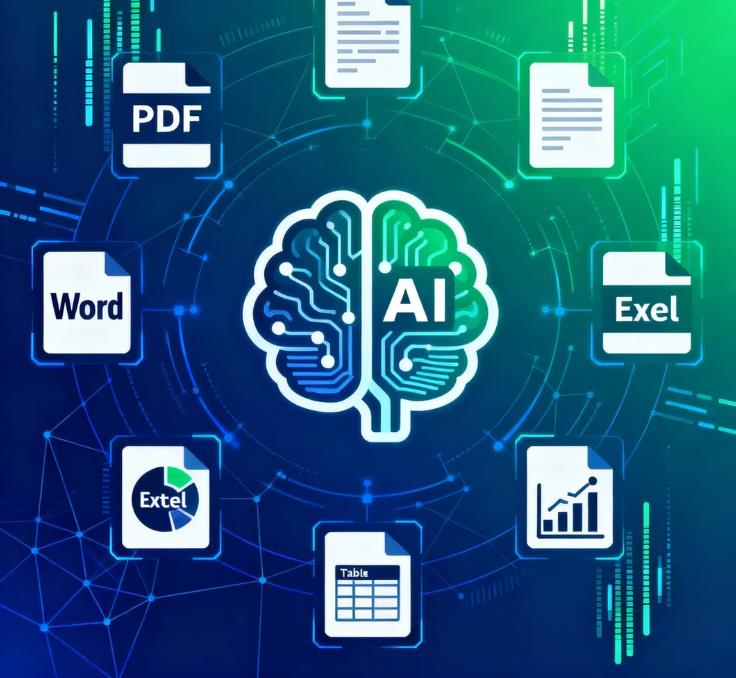

In today’s digital-first economy, organizations are drowning in documents. Invoices, contracts, bank statements, insurance claims, medical records, onboarding forms, shipping documents, and compliance reports continue to arrive in massive volumes, often in unstructured formats such as PDFs, scanned images, emails, and handwritten forms. Despite the rise of cloud computing and business automation, document-heavy workflows remain one of the largest bottlenecks across industries.
Manual data entry is slow, expensive, error-prone, and nearly impossible to scale. This is where Document AI has become a foundational technology for modern enterprises. By combining Optical Character Recognition (OCR), Natural Language Processing (NLP), Computer Vision, and increasingly large language models (LLMs), Document AI platforms can automatically extract, classify, validate, and integrate data from virtually any document type.
For businesses in North America and Europe, Document AI is no longer an experimental tool. It has become a mission-critical layer within finance automation, compliance workflows, digital transformation strategies, and intelligent process automation. This guide provides a comprehensive, enterprise-focused overview of the best Document AI tools for data extraction and document management in 2025, along with selection strategies, real-world use cases, and future trends shaping the industry.
Understanding Document AI and How It Works in Business Environments
Document AI refers to a category of artificial intelligence systems designed to interpret, extract, and manage information from both structured and unstructured documents. While traditional OCR focuses primarily on converting images into machine-readable text, Document AI goes several layers deeper by understanding the semantic meaning of that text.
A modern Document AI pipeline typically includes:
Document ingestion through file uploads, email parsing, API endpoints, or cloud storage connectors. Image preprocessing that enhances low-quality scans, removes noise, corrects skew, and standardizes formatting. OCR engines that convert text from documents into digital characters. NLP and deep learning models that identify entities, relationships, tables, key-value pairs, and contextual meaning. Validation and business rules engines that check extracted data for accuracy and consistency. Integration layers that push structured data into ERP, CRM, accounting, HR, RPA, and analytics platforms.
Unlike template-based systems of the past, leading Document AI platforms now leverage machine learning models that adapt to variations across suppliers, geographies, languages, and document layouts. This allows enterprises to process large volumes of heterogeneous documents with minimal manual intervention.
Why Document AI Has Become a Strategic Technology for Enterprises
The explosive adoption of Document AI across Western markets is driven by several large-scale economic and regulatory factors.
The growth of remote and hybrid work models has massively increased the use of digital documents and decentralized processing. Enterprises require secure automation that does not depend on physical offices or paper workflows. Regulatory compliance in regions governed by GDPR, SOC 2, PCI DSS, and HIPAA requires consistent, auditable, and secure handling of sensitive information. Manual processes struggle to meet modern audit requirements.
Finance and operations teams are under pressure to reduce operational costs while increasing processing speed. Document AI enables straight-through processing, allowing invoices, claims, and financial documents to be handled automatically without manual touchpoints. Competitive pressure is also driving adoption. Companies that automate document workflows gain faster access to business intelligence, real-time reporting, and improved customer experience.
For small and medium enterprises, cloud-based Document AI levels the playing field by making enterprise-grade automation accessible without massive upfront infrastructure investments.
Key Evaluation Criteria for Modern Document AI Platforms
Selecting a Document AI platform is not merely a technical decision. It is a business-critical investment that directly impacts operational efficiency, data quality, compliance, and scalability. The most reliable evaluation frameworks combine technical performance with enterprise readiness.
Extraction accuracy across structured and unstructured documents remains the primary metric of value. Leading platforms now achieve high accuracy even on low-quality scans, handwritten inputs, and multi-language documents. The ability to work without predefined templates is increasingly important for organizations that process documents from thousands of vendors and partners.
Model training and customization capabilities allow organizations to improve accuracy over time using their own datasets. API maturity determines how deeply Document AI can be embedded into business systems. Enterprises typically require REST APIs, webhooks, batch processing, and real-time processing options.
Security and compliance certifications are non-negotiable in Western markets. SOC 2 Type II, GDPR compliance, ISO 27001, and data residency controls are baseline requirements. Healthcare and financial institutions often require HIPAA and PCI DSS alignment.
Pricing structure also plays a key role. Some vendors charge per page, some per API call, while others offer subscription-based enterprise licenses. Total cost of ownership depends on volume, accuracy, human review needs, and system integration complexity.
Leading Document AI Tools for Data Extraction and Management
The Document AI market has matured into a diverse ecosystem that includes hyperscale cloud providers, niche enterprise vendors, and developer-centric API platforms. Each category serves different segments of the market.
Google Cloud Document AI
Google Cloud Document AI is one of the most technically advanced platforms in the market. Built on Google’s machine learning infrastructure, it offers pre-trained processors for invoices, receipts, contracts, identity documents, and financial forms. It also enables custom model training using AutoML.
The platform integrates natively with Google Cloud Storage, BigQuery, and Vertex AI, allowing enterprises to create end-to-end data pipelines. It supports multiple languages, high-volume batch processing, and real-time API calls. Security and compliance standards meet the requirements of heavily regulated industries.
Google’s solution is best suited for enterprises already invested in the Google Cloud ecosystem, as well as organizations seeking large-scale, global document processing with advanced analytics.
Amazon Textract
Amazon Textract is Amazon Web Services’ fully managed document extraction service. It specializes in highly scalable OCR and form analysis for documents including invoices, forms, tables, and insurance records.
Textract integrates tightly with AWS services such as S3, Lambda, Comprehend, and Amazon RPA solutions. It is widely adopted in financial services, government operations, and large-scale enterprise back-office automation.
While Textract offers high performance and scalability, complex data validation and workflow orchestration typically require complementary AWS services or third-party platforms.
Microsoft Azure Form Recognizer
Azure Form Recognizer, now part of Azure AI Services, provides AI-powered form processing with prebuilt and custom models. It supports receipts, invoices, ID documents, tax forms, and custom document types.
The platform integrates seamlessly with Microsoft Power Automate, Dynamics 365, and Azure Cognitive Services. For enterprises operating in Microsoft-centric environments, Azure provides a unified automation and data management stack.
Azure’s compliance portfolio is one of the strongest in the market, making it a preferred choice for regulated European enterprises and public sector organizations.
ABBYY FlexiCapture
ABBYY is a long-established leader in document processing and intelligent OCR. ABBYY FlexiCapture is an enterprise-grade document processing platform widely used in banking, healthcare, logistics, and shared service centers.
Its core strengths lie in advanced recognition accuracy, rule-based validation, and complex document classification. ABBYY also supports hybrid deployment models, including on-premise, private cloud, and fully managed cloud services.
FlexiCapture is often selected by organizations requiring deep control over data handling and regulatory compliance in sensitive environments.
Rossum
Rossum is a modern cloud-native Document AI platform focused primarily on transactional documents such as invoices, purchase orders, and shipping documents. It leverages deep learning models rather than rigid templates, allowing robust performance across diverse supplier formats.
Rossum integrates with popular accounting and ERP platforms such as SAP, NetSuite, QuickBooks, and Xero. Its intuitive validation interface enables finance teams to correct ambiguous data with minimal friction.
The platform is particularly popular among mid-sized enterprises seeking rapid deployment without extensive IT overhead.
Hyperscience
Hyperscience specializes in automating highly complex and messy documents often found in government, healthcare, and insurance sectors. It uses a combination of deep learning and human-in-the-loop augmentation to continuously improve extraction accuracy.
Its ability to handle handwritten documents, legacy forms, and non-standard layouts makes it attractive for organizations undergoing long-term digital transformation of historical processes.
Hyperscience is typically adopted in large-scale enterprise and public sector environments with strict accuracy and security requirements.
Nanonets
Nanonets is a developer-friendly Document AI platform that provides rapid model training and flexible API access. It supports invoices, receipts, ID verification, engineering drawings, and custom document types.
Its strength lies in low friction deployment, fast onboarding, and cost-effective pricing for growing businesses. Nanonets also integrates with Zapier, Make, Slack, and popular cloud storage platforms.
This platform is frequently chosen by startups, SaaS companies, and automation engineers building agile document workflows.
Docsumo
Docsumo focuses on intelligent data extraction for financial, logistics, and compliance-heavy documents. It provides pre-trained and custom AI models along with strong annotation, validation, and review workflows.
The platform is widely used by insurance companies, lenders, and fintech firms that require consistent data quality across high-volume document processing environments.
Docsumo emphasizes human-in-the-loop validation, making it suitable where absolute accuracy is mission-critical.
Industry-Specific Applications of Document AI
Document AI delivers unique value across vertical industries, each with its own regulatory, operational, and accuracy constraints.
In finance and accounting, Document AI automates invoice processing, expense extraction, bank statement reconciliation, and audit documentation. It enables faster accounts payable cycles, improved cash flow visibility, and reduced fraud risk.
In legal and compliance operations, Document AI extracts clauses, obligations, and key terms from contracts and regulatory filings. Law firms and corporate legal departments use it to manage large contract portfolios and accelerate due diligence.
Healthcare organizations rely on Document AI to digitize medical records, insurance claims, consent forms, and referral documents. Automation reduces administrative burden while maintaining HIPAA-level data protection.
E-commerce and retail companies apply Document AI to supplier invoices, logistics documents, customs declarations, and product certifications. This contributes to faster supply chain management and inventory optimization.
Human resources departments use Document AI to automate resume processing, onboarding documentation, background verification, and payroll records. This shortens hiring cycles and improves employee experience.
Insurance providers process enormous volumes of claims, policy documents, and supporting evidence. Document AI enables near real-time claims triage and risk assessment.
Real-World Challenges in Enterprise Document AI Adoption
Despite its transformative potential, Document AI implementation is not without challenges. Data privacy and security remain primary concerns, especially when processing sensitive personal or financial information. Enterprises must ensure strict access control, encryption, and auditability.
Accuracy limitations still exist for highly unstructured, damaged, or multilingual documents. Even advanced AI models may require periodic human validation to maintain compliance standards.
Integration complexity is another frequent barrier. Legacy ERP, CRM, and document management systems often lack modern API interfaces, requiring custom connectors or middleware layers.
Employee adoption and change management also affect success. Automation shifts job responsibilities from data entry to exception handling, analysis, and process optimization. Organizations must invest in training and workflow redesign.
Integration of Document AI with RPA, ERP, and Large Language Models
The most powerful Document AI deployments today are no longer standalone tools. They form part of broader intelligent automation architectures.
When combined with Robotic Process Automation platforms such as UiPath, Automation Anywhere, and Microsoft Power Automate, Document AI enables fully automated end-to-end workflows. For example, an invoice can be extracted, validated, approved, and posted into an ERP system with zero human intervention.
ERP integration with SAP, Oracle NetSuite, and Microsoft Dynamics allows structured document data to directly feed financial reporting, procurement, and compliance modules.
The integration of Document AI with large language models introduces a new level of intelligence. Enterprises can query documents using natural language, perform automated audits, generate compliance reports, and summarize contract obligations at scale. This convergence is creating a new class of intelligent document systems that extend beyond traditional extraction.
How to Choose the Right Document AI Tool for Your Business
Selecting the appropriate Document AI solution depends heavily on organizational context. Small businesses prioritize affordability, ease of deployment, and quick ROI. Mid-sized companies often seek scalability, ERP integration, and consistent data quality. Large enterprises require governance, compliance, security, and customizable workflows across business units.
Organizations should evaluate document types, volume expectations, accuracy requirements, budget constraints, and IT capabilities. Pilot projects using real production data provide the most reliable insight into performance and total cost of ownership.
Vendor stability, roadmap transparency, customer support, and ecosystem partnerships have become increasingly important as Document AI evolves from a tool into long-term infrastructure.
Future Trends Shaping the Document AI Market
The future of Document AI is increasingly driven by multimodal AI models that process text, images, and layout simultaneously. Zero-shot extraction techniques will reduce the need for lengthy model training.
Self-learning systems will continuously improve using enterprise feedback loops. The integration of knowledge graphs will enable advanced reasoning across document repositories.

Regulatory-driven AI governance frameworks in Europe and North America will shape how Document AI systems are deployed, audited, and certified.
As AI-powered document processing becomes ubiquitous, data extracted from documents will feed directly into real-time analytics, forecasting, and decision intelligence platforms.
The Strategic Importance of Document AI in the Modern Enterprise
Document AI has evolved from a niche automation tool into a core enterprise capability. It bridges the gap between unstructured information and structured business systems, unlocking data that was previously trapped inside documents.
For organizations operating in competitive, regulated, and data-driven environments, Document AI is not simply about reducing manual labor. It is about building faster, more resilient, and more intelligent operational models.
As global enterprises continue to digitize their workflows, the companies that invest early in scalable, secure, and intelligent document processing infrastructure will gain lasting advantages in efficiency, compliance, and business insight.